10 Aug 2026Alcohol-Free Travel
How to Choose the Right Alcohol-Free Retreat for You
Compare alcohol-free retreats by pace, activities, group dynamics, accommodations, cost, and alcohol policy to find a trip that genuinely fits you.
How to Choose the Right Alcohol-Free Retreat for You
Figuring out how to choose an alcohol-free retreat can be harder than finding one you like.
The photos may be beautiful. The activities sound fun. The destination has been sitting on your travel list for years. Still, none of that tells you how it’ll feel to wake up there on the second morning, join the group for breakfast, and move through the day.
One retreat might revolve around yoga, quiet afternoons, and time at the property. Another might involve early starts, guided hikes, and a full schedule of local experiences. Both can offer an enjoyable alcohol-free trip, but they’ll ask different things of your energy, attention, and comfort.
The right retreat isn’t necessarily the one with the most activities or the most impressive setting. It’s the one with rhythm that fits the experience you want.
This guide will help you compare the details that shape an alcohol-free retreat, including the pace, activities, group dynamic, accommodations, alcohol policy, and total cost.
If you’re still learning how these trips work, start with What Is an Alcohol-Free Retreat, and Is It Right for You?
Start with the experience you want
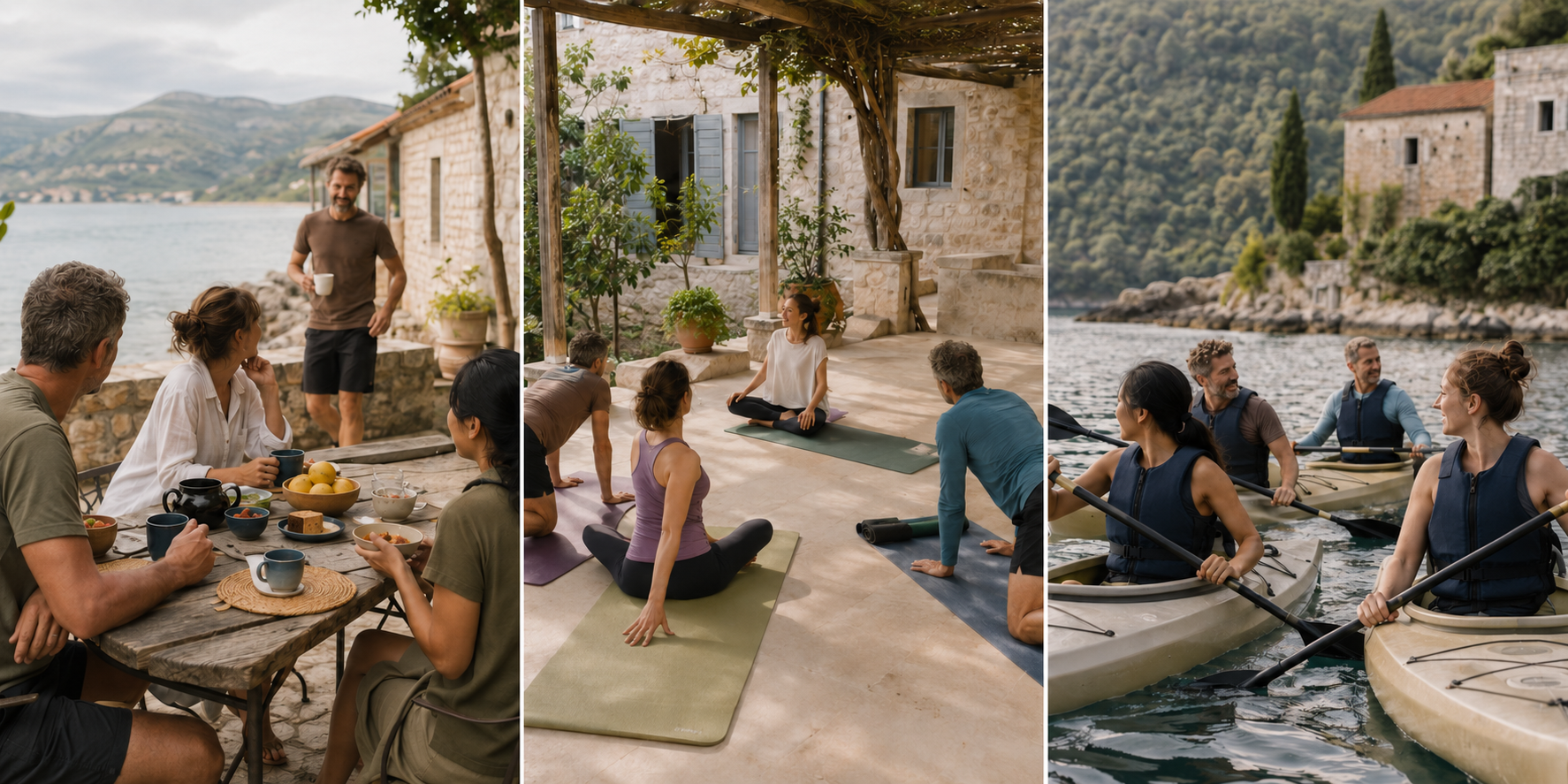
Before opening ten retreat pages and comparing destinations, take a moment to think about why you want to go.
Maybe you’re ready for a trip where someone else handles the plans. You might want to meet people who are also interested in alcohol-free travel, spend more time outside, try something new, or simply have a week that feels different from life at home.
Try to choose one or two priorities. A single retreat probably won’t offer deep rest, constant adventure, cultural immersion, personal reflection, unlimited free time, and a packed social calendar equally well.
Your priorities might sound like:
I want an active trip that gets me outdoors.
I want to meet people without spending every hour in a group.
I want to visit somewhere new without planning every detail myself.
I want a gentle first experience with group travel.
I want time to rest without being pushed toward a personal breakthrough.
I want evenings that still feel social and special without revolving around alcohol.
There doesn’t need to be a dramatic reason behind your choice. Wanting a memorable trip in good company is enough.
Once you know what you want to gain from the experience, the marketing becomes easier to filter. A gorgeous property might matter more if the retreat barely leaves it. An ambitious itinerary might lose its appeal if what you really want is room to breathe.
Use this alcohol-free retreat comparison checklist
When several trips appeal to you, compare them using the same criteria. Otherwise, it’s easy to weigh one retreat by its destination, another by its price, and a third by a single activity you love.
Compare | What to check | Ask yourself |
|---|---|---|
Purpose | The retreat’s main focus and intended experience | What do I want this trip to give me? |
Alcohol-free approach | Policy, language, social plans, and expectations | Does this approach fit how I want alcohol-free travel to feel? |
Pace | Start times, scheduled hours, transfers, and downtime | Will this rhythm energize me or wear me out? |
Activities | Type, difficulty, frequency, and whether they’re optional | Would I choose these activities for myself? |
Group experience | Group size, shared meals, facilitated time, and free time | How much interaction feels comfortable? |
Privacy | Room type, bathrooms, quiet space, and location | What do I need to recharge? |
Destination | Time spent exploring, local experiences, and setting | Do I like how this retreat experiences the destination? |
Cost | Inclusions, extras, transportation, and room supplements | What will the whole trip actually cost? |
You don’t need every category to be perfect. Decide which details are essential, which are strong preferences, and which would simply be nice to have.
Look beyond the alcohol-free label
“Alcohol-free retreat” can describe several different kinds of experiences.
Some are conventional retreats where alcohol simply isn’t served. Others intentionally build dinners, celebrations, and group activities around connection without drinking. Recovery-oriented retreats may include structured sobriety discussions, therapeutic elements, or program-specific language.
None of these approaches is automatically better. They’re designed for different people and purposes.
If you don’t identify as sober or aren’t looking for recovery-focused programming, you’ll probably want to know whether sobriety discussions are central, optional, or largely absent. If maintaining an alcohol-free environment throughout the trip matters to you, you’ll need more detail than a promise that drinks won’t be served at the accommodation.
Before booking, consider asking:
Does the alcohol-free policy apply throughout the whole retreat?
Are guests expected not to drink during free time or independent outings?
How are off-site dinners handled?
Are alcohol-free drinks available during social occasions?
Do evening activities have a clear plan, or does the schedule simply end after dinner?
Is the retreat framed around travel, wellness, recovery, or a mix?
Are personal conversations about sobriety expected, encouraged, or completely optional?
A host should be able to answer these questions clearly and without making assumptions about your relationship with alcohol.
This is one of the biggest differences between choosing a general retreat and choosing an alcohol-free retreat. You’re not only checking what’s absent. You’re looking at what the experience offers in its place.
Read the itinerary like you’ll have to live it
Retreat names can only tell you so much. A sample day reveals far more.
A yoga retreat could include several hours of daily practice with most of the remaining time spent at the property. Another might offer one optional morning class before the group heads out to explore. An adventure retreat might mean demanding hikes and early departures, or it could involve gentle outdoor activities, guided walks, and trying new things at a comfortable pace.
Look at the shape of the whole day:
What time does the first activity begin?
How long are the scheduled activities?
How much travel is involved?
Are most meals shared?
Which activities are optional?
Is downtime genuinely open, or will it be used for transfers and getting ready?
How many active days happen in a row?
Picture the second full day. You slept lightly, breakfast starts at 7:30 a.m., and the group leaves for a four-hour hike at 8:15. There’s a short break before dinner. Would that sound exciting, or would you already be longing for a slower morning?
A long list of inclusions can look like good value, but you still have to enjoy the pace required to fit them all in.
The reverse matters too. Spacious afternoons may sound wonderful until you realize you prefer to fill your trips with sightseeing. There’s nothing wrong with wanting momentum. The point is to choose for the traveler you already are, not the traveler you imagine becoming once you arrive.
Choose activities you’d genuinely enjoy
The retreat’s activities will shape both your days and the way you get to know the group.
Yoga-led retreats often create a steady rhythm. Returning to the same practice each day can feel grounding, especially in a quieter setting. Check how often classes are offered, what level they’re designed for, and whether participation is optional.
Adventure-led trips may make connection feel easier because people are doing something together. Hiking, paddling, cycling, guided walks, and hands-on activities provide a natural focus for conversation. Still, “adventure” can cover a wide range of physical demands.
Ask for specifics when descriptions rely on words such as moderate, accessible, immersive, or challenging. Find out about duration, terrain, elevation, equipment, rest stops, and alternatives.
Also consider retreats built around food, culture, creativity, nature, or rest. The best fit may combine several themes rather than falling neatly into one category.
A useful test is simple: Would you still want to do these activities if they weren’t part of an alcohol-free retreat?
If the answer is no, the shared alcohol-free element may not be enough to carry the experience. Connection matters, but you’ll also spend several hours each day following the itinerary.
Think about how you like to connect
An alcohol-free setting gives the group a shared starting point. Drinking won’t determine where people gather, what happens at dinner, or how an evening becomes social. That can make room for different kinds of interaction, but every retreat handles group connection differently.
Small groups may make it easier to learn everyone’s name and spend meaningful time together. They can also feel quite intimate. If you prefer moving between conversations or stepping back without being noticed, a slightly larger group may feel more comfortable.
The itinerary matters as much as the headcount. Shared challenges and hands-on activities let relationships develop while people are occupied with something else. Workshops and facilitated conversations create more direct opportunities for personal sharing. Plenty of communal meals can encourage connection, but they may feel tiring if you need quiet time to reset.
If you’re attending alone, ask how the retreat handles the first day. Clear arrival instructions, introductions, a welcoming first activity, or a way to connect with other guests beforehand can ease the transition.
You should also be able to participate without disclosing personal details you’d rather keep private. A shared interest in alcohol-free travel doesn’t mean everyone has the same story, identity, or reason for being there.
For more on arrival, downtime, and joining a new group, see Your First Alcohol-Free Retreat: What to Expect.
Be honest about how much privacy you need

Privacy can look like an optional upgrade during booking. After a full day of conversation, shared meals, and activities, it may be what allows you to enjoy the rest of the trip.
A private room offers a reliable place to recharge, but it may increase the cost. A shared room can make the retreat more affordable and create another point of connection. It also means adapting to someone else’s sleeping habits, alarms, belongings, and need for quiet.
The property makes a difference too. A remote villa may create a close group atmosphere, but you might have few alternatives if you skip an activity. A hotel in a walkable area can offer more independence, though the trip may feel less secluded.
Check the details that rarely lead the photo gallery:
Private and shared room options
Bathroom arrangements
Roommate matching
Quiet hours
Accessibility
Spaces for spending time alone
Distance from activities
Transportation if you choose not to join part of the itinerary
These aren’t minor logistical questions. Sleep, privacy, and the ability to step away can affect how present you feel for everything else.
Separate the destination from the retreat
A destination can be so appealing that it distracts from the experience being offered there.
Ask yourself two separate questions:
Do I want to visit this place?
Do I want to visit it in this particular way?
A retreat may take place somewhere you’ve always wanted to see while spending most of the week at one property. Another might include local guides, daily excursions, meals in different settings, and time to explore independently.
Neither approach is inherently better. One offers a sense of retreating from everyday life. The other may give you a fuller introduction to the destination.
Look for details about how the itinerary engages with local food, history, nature, and culture. Check how much time you’ll spend in transit and whether the schedule leaves room for independent exploration.
Current weather, entry requirements, transportation, accessibility, and local operating schedules should always be verified before booking. Don’t rely on general destination descriptions when those details could affect the trip.
If you’d rather plan an independent journey, check out The Complete Guide to Alcohol-Free Travel.
Calculate the cost of the whole trip
The listed retreat price is only useful when you know what it includes.
One retreat might cover accommodations, most meals, activities, equipment, local transportation, and airport transfers. Another may include the room and core programming while leaving several meals, excursions, and transfers to each guest.
Compare the complete cost, including:
Accommodation and room type
Meals
Activities and equipment
Local transportation
Arrival and departure transfers
Flights or other travel to the destination
Gratuities
Optional excursions
Travel insurance
Single-room supplements
Cancellation terms
Value is personal. Paying more for a private room, a smaller group, an experienced host, or activities that would be difficult to arrange yourself may feel worthwhile. A lower-priced option with more flexibility might suit someone else better.
Don’t count inclusions you wouldn’t have chosen as savings. The better value is the retreat that spends your money on the parts of the trip you care about.
Questions to ask before booking an alcohol-free retreat
By this point, you may have a favorite. Before booking, check for gaps between what the retreat page promises and what you need to know.
Ask the host:
What does a typical day actually look like?
Which activities and meals are optional?
How much free time will I have?
What does the activity level involve in practical terms?
What’s the group size?
How does the alcohol-free policy apply during free time and off-site activities?
How are solo travelers welcomed into the group?
What room and bathroom arrangements are available?
What isn’t included in the price?
What happens if I can’t or don’t want to join an activity?
What are the cancellation and transfer terms?
You don’t need to interrogate the host or eliminate every unknown. Travel always contains a few surprises. You’re looking for clear answers to the details that could materially affect your comfort, budget, or ability to participate.
Choose the retreat whose ordinary moments appeal to you
No retreat can promise perfect weather, instant friendships, or a life-changing result. It can give you enough information to decide whether its rhythm, setting, activities, and approach feel right.
Sort your criteria into three groups:
Essential
Strong preference
Nice to have
Your essentials might include a consistent alcohol-free policy, a private room, specific accessibility provisions, or an alternative to a demanding activity. Group size and the balance between rest and exploration may be strong preferences. A pool, a particular workshop, or one extra excursion might be nice without deciding the whole trip.
Then think past the highlight reel. Picture breakfast, the time between activities, the shared dinners, and the hour before bed. Those ordinary moments will make up much of your experience.
A well-designed retreat should help you picture them before you commit. You should understand the pace, know what’s included, and feel comfortable asking about anything that remains unclear.
Choose the trip that feels like a good fit for your real interests and energy. That’s far more useful than choosing the version of yourself you think should want the busiest itinerary, the deepest transformation, or the most photogenic destination.
Ready to find a trip that fits?
Explore upcoming alcohol-free retreats and group trips, including destinations, accommodations, activities and what’s included.
Not ready to choose a trip yet? Join the Dry Tripping Travel email list for new destination announcements, upcoming trip details and early booking opportunities.